Choosing a Folding Camp Seat by Weight, Height and Ground Conditions
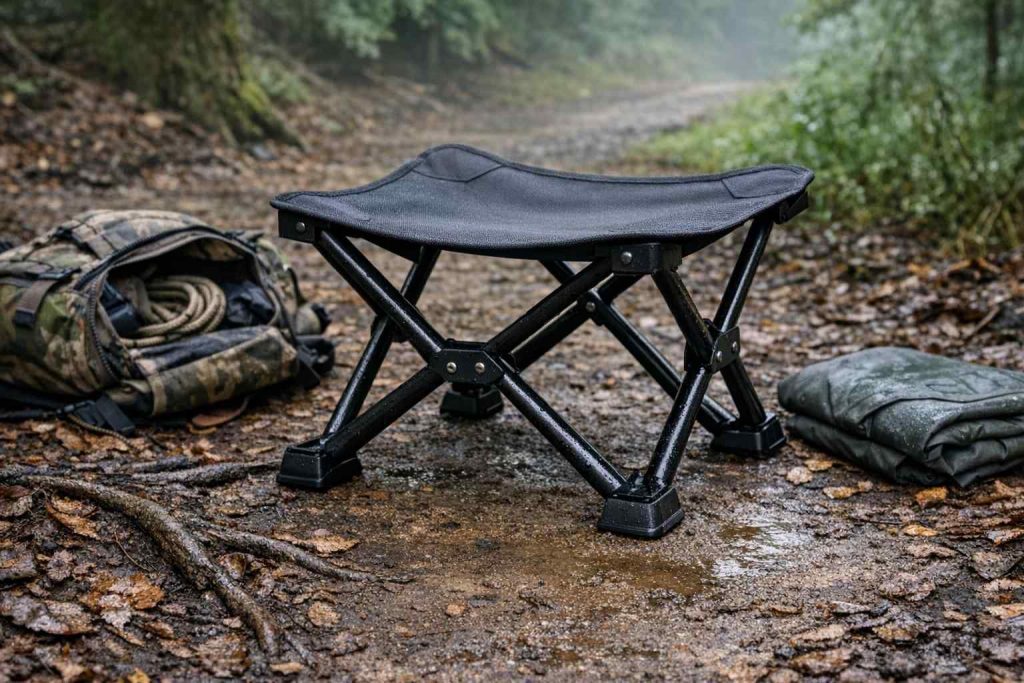
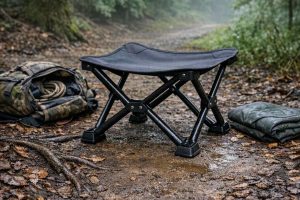
You might think that a small seat is important for changing the perception of a long glassing stop, or for a lunch break or a wait on the trail. But convenience above all goes hand in hand with more than just folding up. Above all a seat for a hunter has to be matched to the hunter, the load and the ground. A simple scenario: after a long day of hunting you arrive at your familiar sit after a rainy day. Is it any good?
Start with the person and the complete load
So you are carrying several pieces of kit to the field in question. In addition to your own body weight your seat is going to have to withstand the weight of your binoculars, your pack, your weather layer and all the other pieces of kit you happen to be carrying down to the field. Also it will experience all the various stresses placed upon it by your lowering yourself down to sit comfortably, leaning to one side to reach something that you have placed in the corner of the seat and so on.
Thus, the weight capacity is just the beginning. Take into consideration the user's clothing, as well as the heavy pack that they will be sitting with. It is also important to remember that people's habits when using seating, in particular when sitting for long periods of time, can be less than ideal. So make sure you clear up any ambiguity regarding the seating capacity.
Also take into account the user's dimensions. A seat which is too narrow can be fine in camp but annoyingly constricted during long observations, whilst very wide chairs are great for camp but a pain to get into small clearings or between trees and walls. Get the seat that most closely matches how you sit.
Seat height changes the whole sitting position
Once weight capacity has been established for your needs, think about the body position for sitting and for standing. A low seat will allow a very narrow profile while hunting but place greater strain on your legs and knees for each up and down. Will this be acceptable for the occasional short stop or not?
While a taller seat is usually better for camping for creating a comfortable sitting position, it also has the potential to raise the center of mass for the person seated on it. Thus it can be less ideal on uneven ground. You will need to balance this against the footprint of the frame and your ability to stand up over it comfortably.
In practical terms, that would mean thinking about the task you want to do. A short sit for observation would require a low and lightweight seat, while longer periods of sitting for camp cooking, calling, or watching from the side of a vehicle would require a higher seat and more support. Attempting to move around while seated – i.e. sitting down, leaning to one side to reach for something in your pack, standing up – is also worth trying in order to get a sense of whether or not you can use the seat for what you need to do.
Read the ground before choosing the frame
While the same seat will sit well on a solid and dry surface such as packed soil or a firm campsite, it can feel somewhat insecure on surfaces such as wet leaf litter covered ground. First clear any clutter from the area where you intend to sit, and then inspect the ground for soft spots, roots, stones, etc. Also be aware that a seemingly level spot can compress under the weight of one leg whilst the other legs sit firm.
Even the widest of stable chairs cannot be set down on soft, fragile or sensitive areas of the ground. Test the seat by gently pushing down on the leg(s) prior to lowering your body onto the seat. Also take note of the ground slope prior to opening up the seat. Try to sit the chair up so that it won't fall over to one side. Also avoid placing the legs of the seat in areas where they could slip and slide down a bank or into a ditch etc.
It is also important to keep in mind the impact your seat is having on the environment. You want to be able to set up your seat in a spot where you can sit and observe your surroundings without to crush sensitive plants or to widen a trail. Look for existing clearings to set up in and avoid sitting in sensitive wet areas. If you must go through vegetation to get to your seat, try to move it rather than dragging it. Make sure to bring back damaged straps, broken caps, etc. instead of leaving them behind.
Match portability to the distance you will carry it
Weight is a consideration when you will be carrying other items such as hunting optics, water, and other items of clothing. A seat of moderate weight is better than one that will become a burden after a short period of time. Also the folded length of the seat must be sufficient to pack it away easily and to allow it to be secured in place, yet not so small that it compromises on seat size and stability.
If you're going on a short approach then the extra strength of the frame for a sturdy seat is a worthwhile sacrifice for better comfort and stability. However, if you're going on a mobile hunt and you're going to be setting up and taking down your seat at many different locations then the seat's weight and ease of set up and pack down become more important than lots of padding and comfort.
Look for tears, stretched stitching or sharp edges on the fabric or webbing. Also make sure that locking points lock, that hinges don't bind when you fold up the seat and that all parts of the frame are not bent or broken in any way. Keep your fingers away from the joints of the frame when opening and closing the seat.
Make the choice fit the outing
Returning to the rainy field-edge, remember that the best 'hunting seat' is that which has sufficient capacity for you and your gear, is of a height to enable easy sitting and rising and whose legs can be placed upon the ground to provide your seat with stability and not cause undue damage to surrounding flora and fauna.
When choosing a chair for mixed use consider where compromise will be a problem: extra weight on the port to the location you will be using it on, less comfort on long sits, or uncertainty as to how it will perform on soft ground.
Some outdoor activities and season uses are regulated on public and state lands. Do yourself a favor and check for current restrictions before you head out. A good portable seat for hunting is not going to solve all the problems for you in the field but it can eliminate a major source of discomfort and distraction. Make sure your portable seat works for the person who is going to be using it and for the load of gear that he or she will be carrying, and then choose the best seat for the ground on which you will be sitting.